

GOST and API Standards: Drill Pipe, Casing, Threads and Steel Grades
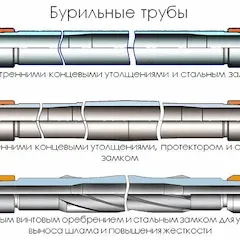
GOST, API and Chinese industry standards are not a formality — they exist to ensure that the pipe, tool joint, thread and steel grade work together as a single, safe system. A standard defines the fundamental parameters: outside and inside diameter, wall thickness, tolerances, strength, thread type, inspection scope and marking requirements. In drilling, casing and well completion, a mistake in the standard is not merely a warehouse inconvenience — it creates risks of incompatibility, resource loss, thread stripping, leakage or an unplanned work stoppage.
In practice, engineers, supply managers and procurement specialists need to quickly understand how GOST differs from API, where a Chinese standard essentially mirrors API, how to cross-reference ZP-176 with NC38 and ZP-266 with NC50, and how to read steel grades. This is especially important when selecting drill pipe, casing pipe and tubing for projects where Russian, imported and Chinese items appear side by side. Below is a practical reference covering the main standards, threads, strength grades and document checks before purchase.
Why Standards for Drill Pipe and Casing Pipe Matter
Standardisation in tubular goods addresses four practical objectives: safety, compatibility, interchangeability and quality assurance. If a pipe is manufactured to a recognised standard, its mechanical properties can be assessed in advance, the correct thread can be selected, the string can be designed, and its behaviour under torque, tension, bending, internal pressure and cyclic loading can be predicted.
For drill pipe the standard is especially important because it operates dynamically — rotating, carrying axial load, absorbing impact and abrasive wear. For casing pipe the priority is different: leak-tightness, resistance to external pressure, durability and correct thread performance after run-in and cementing. For tubing (NKT), working pressure, fluid environment, corrosion resistance and compatibility with wellhead equipment and couplings come to the fore.
From a practical standpoint, a standard is the common language between the mill, the procurement team, the rig and incoming inspection. If a requisition states API 5DP G105 NC50, or alternatively GOST with steel grade M and tool joint ZP-266, the specialist immediately knows what needs to be matched. That is why, when selecting products for a project, it is important to look not only at the price but also at the actual standard, thread type, inspection protocols and pipe origin.
Main Russian GOST Standards
GOST Standards for Drill Pipe
In Russian practice, drill pipe and its components are most commonly governed by GOST R 50278-92 and GOST 28487-90. The first standard sets requirements for drill pipe with threaded connections and effectively serves as the Russian point of alignment with the international API 5DP system. The second standard covers tool joint threads: it is the convenient reference for understanding the geometry of domestic connections and their cross-reference to the API NC series.
Simply put, GOST R 50278-92 answers the question of what the drill pipe itself must be, while GOST 28487-90 defines what the tool joint thread must be and how reliably it will perform in the string. For procurement this is especially important: a pipe may formally fit by size but actually be incompatible by connection, gauge or tool joint condition.
GOST 632-84 and GOST R 53366-2009 for Casing Pipe
For casing pipe in the Russian context, GOST 632-84 and GOST R 53366-2009 are typically considered. GOST 632-84 is the classic domestic casing pipe standard, still frequently referenced in specifications, requisitions and inventory records. GOST R 53366-2009 is closer to modern international practice and is harmonised in intent with API 5CT and ISO 11960.
This distinction matters at the procurement stage. Where the task involves Russian warehouse stock, legacy inventory, repair or replacement of existing strings, GOST 632-84 remains the working reference point. If the project is built around international documentation, operator requirements or imported materials, GOST R 53366-2009 and API 5CT are the logical choice. When selecting casing pipe, this helps quickly identify which steel grades, thread types and inspection levels are actually required for a specific well.
American API Standards
API Spec 5DP
API Spec 5DP is the primary international standard for drill pipe. It covers dimensions, steel grades, testing requirements, marking and inspection levels. In the market it is effectively the international benchmark: if a pipe is supplied to API 5DP, comparison between manufacturers, projects and countries is straightforward.
The key advantage of API 5DP is its clear, unified steel grade system: E-75, X-95, G-105, S-135 and above. For the engineer this is convenient — the load range and intended application of the pipe are immediately legible. For procurement the benefit lies elsewhere: a valid API licence and correct marking simplify incoming inspection and reduce the risk of buying an "equivalent with no supporting documentation."
API Spec 5CT
API Spec 5CT applies not to drill pipe but to casing and production tubing. It is the base standard for casing and tubing. Here different grades apply: H40, J55, K55, N80, L80, C90, T95, P110, Q125. These grades follow a different engineering logic: what matters is not torque transmission and fatigue strength, but internal and external pressure resistance, leak-tightness and environmental compatibility.
API 5DP and API 5CT must therefore not be conflated. API 5DP covers the drill string and its dynamic service. API 5CT covers casing and well completion. In practice the error often occurs here: users see a familiar "API" designation and assume the pipe is interchangeable. The correct approach is to check the intended application, not just the standard code.
Chinese Standards and Their API Equivalence
The Chinese standards most commonly encountered in the drilling and tubular goods market are SY/T 6194 for drill pipe and GB/T 19830 for casing and tubing. Their practical feature is that many Chinese mills build their production around API requirements and effectively manufacture products closely aligned with API 5DP and API 5CT.
This does not mean any Chinese pipe can automatically be treated as equal to API. The correct logic is: Chinese standards are often harmonised with API in terms of dimensions, steel grades and thread types, but actual quality is determined not by the standard name but by the mill, the documents and the real inspection level. That is why, when procuring Chinese-origin products, it is necessary to check the marking, certificate, MTC, non-destructive testing results and the manufacturer's current API licence if the pipe is sold as API-compatible.
In practice this works straightforwardly. If a Chinese drill pipe is supplied to SY/T 6194, carries grades E75, X95, G105 or S135, has clear marking, a legible heat number and thread documentation, it can be treated as a working equivalent to API 5DP. However, if the pipe lacks clear traceability, the threads are unverified and the documents are merely formal, the project risks increase sharply.
Cross-Reference Table: GOST, API and Chinese Standards
| System | Application | Diameters | Steel grades | Thread types | Nature of equivalence |
|---|---|---|---|---|---|
| GOST R 50278-92 | Drill pipe | Working range close to 60–168 mm | D, E, L, M, R | Domestic tool joint connections; in practice cross-referenced with NC | Russian standard, partially comparable with API 5DP |
| GOST 28487-90 | Tool joint thread for drill pipe | Applicable to standard drill pipe diameters | Does not define pipe steel grade as primary parameter | ZP-76, ZP-93, ZP-176, ZP-266 | Used for cross-reference with NC26, NC31, NC38, NC50 |
| GOST 632-84 | Casing pipe | Wide casing range | D, K, E, L, M | Short, long triangular, trapezoidal | Russian basis for casing; cross-referenced with API 5CT by application |
| GOST R 53366-2009 | Casing and tubing | Depends on string size | Engineering logic closer to API 5CT | Casing and tubing thread nomenclature | Harmonised with API 5CT / ISO 11960 |
| API Spec 5DP | Drill pipe | 60.3–168.3 mm and wider in international practice | E-75, X-95, G-105, S-135 and higher | NC, FH, REG, IF | Primary international standard |
| API Spec 5CT | Casing pipe and tubing | Per casing and tubing series | H40, J55, K55, N80, L80, C90, T95, P110, Q125 | STC, LTC, BTC and others | International standard for casing and tubing |
| SY/T 6194 | Drill pipe | Generally close to the API series | E75, X95, G105, S135 | NC, FH, REG, IF | Chinese standard, often harmonised with API 5DP |
| GB/T 19830 | Casing and tubing | Per casing and tubing series | Generally mirrors the API range by application | Per casing and tubing nomenclature | Chinese standard, close to API 5CT |
This table is sufficient for initial selection. If the task is to purchase drill pipe for drilling operations, the relevant references are GOST R 50278-92, GOST 28487-90, API 5DP and SY/T 6194. If the task is casing or well completion, the comparison involves GOST 632-84, GOST R 53366-2009, API 5CT and the corresponding Chinese equivalents.
Thread Connection Cross-Reference
In Russian and international practice, the most commonly used working cross-references are: ZP-176 ≈ NC38 and ZP-266 ≈ NC50. This is not a marketing simplification — it is an engineering relationship actively used when selecting pipe, tool joints and accessories.
| Russian connection | API equivalent | Typical pipe diameter | Practical note |
|---|---|---|---|
| ZP-176 | NC38 | Typically 88.9 mm | Working engineering equivalence for most standard applications |
| ZP-266 | NC50 | Typically 127.0 mm | Frequently used as the primary substitution pairing |
Caution is required here. Compatibility is acceptable when the thread geometry, machining quality, tool joint condition, correct gauge and make-up torque procedure have all been confirmed. If the pipe is new and supplied by a known manufacturer with full documentation, a mixed string using these connections is generally feasible. However, if the pipes are of differing origin, the tool joints are reconditioned, or the items lack clear inspection records, it is better not to rely solely on an "approximate equivalent."
In practice this means: in procurement it is acceptable to state that ZP-176 corresponds to NC38 and ZP-266 corresponds to NC50, but before actual string assembly the threads must be checked with gauges, and the condition of the box/pin faces, fit, lubricant and make-up torque must be verified. This is especially important when using reconditioned or used pipe, where tool joint geometry and actual residual service life must be independently confirmed.
Steel Grades and How to Cross-Reference Them
For quick market selection, a working engineering cross-reference of Russian and API steel grades is commonly used. It is convenient for procurement, sourcing substitutes and preliminary compatibility assessment. However, it is important to understand that this is an engineering cross-reference by strength level and intended use — not always a formally complete legal equivalence of certificates.
| Russian grade | API / Chinese designation | Engineering significance | Note |
|---|---|---|---|
| E | E75 | Standard baseline grade for conventional deep drilling | Most frequently used as the starting point for comparison |
| L | X95 | Higher strength for more demanding service | Suitable for more heavily loaded strings |
| M | G105 | Grade for demanding conditions and directional drilling | Often selected for more severe operating modes |
| R | S135 | High-strength grade for great depths and high loads | Requires closer attention to fatigue and connections |
The table is straightforward. If a project specifies grade E and a supplier offers E75, this is typically a working equivalent by strength logic. If grade M is required, G105 is normally the first reference point. If the specification calls for grade R, S135 is the usual target. However, the final selection is always made not by letters alone but by the full set of parameters: yield strength, tensile strength, tool joint type, actual standard, length, non-destructive testing results and pipe origin.
For casing and tubing the logic is different. The strength grades of drill pipe cannot be mechanically mapped onto API 5CT grades such as L80 or P110, as these belong to a different grading system by design. Comparing drill pipe grade M directly with casing grade P110 is therefore incorrect — the first step is to establish what product is actually being discussed: drill pipe, casing or tubing.
What to Check When Purchasing Pipe to GOST, API or Chinese Standards
First — certificates. If the product is claimed as API, the manufacturer must hold a current API licence, and the documentation must show clear traceability by lot. If the pipe is supplied to GOST, a correct set of mill documents is required, stating the standard, heat number, dimensions, steel grade and test results.
Second — MTC. The Mill Test Certificate must provide specific data for the pipe — not a generic advertising phrase: dimensions, wall thickness, standard, steel grade, chemical composition, mechanical properties, heat number and inspection results. A document without traceability is a weak point in any procurement.
Third — marking. The pipe itself must legibly show the standard, steel grade, size, heat number and other identification information. If a pipe is claimed to be Chinese API-compatible but the marking is unclear or does not match the documents, this is grounds for additional verification.
Fourth — NDT (non-destructive testing). For drill pipe, at minimum the pipe body must be inspected and the tool joints and threads must be checked separately. In practice this covers ultrasonic testing, magnetic particle inspection, condition of the hard-facing, evidence of repair and connection geometry. For warehouse stock, and especially for used items without NDT, the risks increase significantly.
Fifth — steel grade and thread compatibility. Errors here are the most common. It is possible to purchase a pipe of the correct diameter and wall thickness but receive a different steel grade or a connection that will not give a correct string assembly. When purchasing, it is therefore necessary to check not only "127×9" but also the steel grade, thread type, manufacturing standard and intended application.
Sixth — intended application. For any project it is essential to identify upfront exactly what is being purchased: drill pipe, casing pipe, tubing or used pipe for a limited budget and a specific application scenario. A formally similar pipe may not be fit for purpose even if the dimensions are close.
Frequently Asked Questions
Can Chinese pipe be used instead of GOST pipe?
Yes, provided it is not an "anonymous substitute" but a pipe with a clear standard, marking, MTC and confirmed compliance. In engineering practice, Chinese pipe to SY/T 6194 is frequently used as a working equivalent to API 5DP and is then cross-referenced against the Russian nomenclature by dimensions, thread type and steel grade.
Which is better: ZP-176 or NC38?
In practical terms they are close in application and are frequently treated as equivalents. The choice of "which is better" usually comes down not to the designation but to the quality of the specific connection, thread precision, tool joint origin and pipe condition. For a mixed string, correct inspection matters more than the designation itself.
How do GOST and API steel grades compare?
For drill pipe the working cross-reference is E ↔ E75, L ↔ X95, M ↔ G105, R ↔ S135. This is a convenient engineering equivalence, but for a contract or pipe passport the actual standard and real mechanical properties must always be the basis — not just an "approximate equivalent."
How should thread compatibility be checked?
By marking, standard, gauges, geometry, face condition and incoming inspection results. If the string is to be mixed, it is better to check the threads on an actual pair in advance rather than relying solely on the designation in the paperwork.
What matters more when purchasing: the standard or the mill?
Both matter. The standard sets the requirements; the mill demonstrates how fully those requirements are actually met. The market frequently presents situations where the correct standard is formally stated but the execution and inspection levels differ significantly between manufacturers.
Conclusion
GOST, API and Chinese standards should be viewed not as a collection of abbreviations but as a practical tool for selecting the right pipe for a specific task. In brief: for drill pipe it is important to understand the relationship between GOST R 50278-92 / GOST 28487-90 / API 5DP / SY/T 6194; for casing and tubing — GOST 632-84 / GOST R 53366-2009 / API 5CT and their equivalents. Thread designations (ZP and NC), steel grades, marking and documentation always warrant separate attention.
If assistance is needed in selecting pipe by standard, thread type, steel grade and warehouse availability, Burmetsnab supplies drill pipe, casing pipe and tubing. Both new products and practical solutions for specific tasks and budgets can be sourced, with verification by dimensions, thread type and documentation.
Need pipe for your project?
We will select pipe to match your specification and schedule. Price on request.