

Oil production in Iraq
Oil production in Iraq: Rumaila, West Qurna, Majnoon, Zubair, Basra export, OPEC role, production volumes and development prospects.
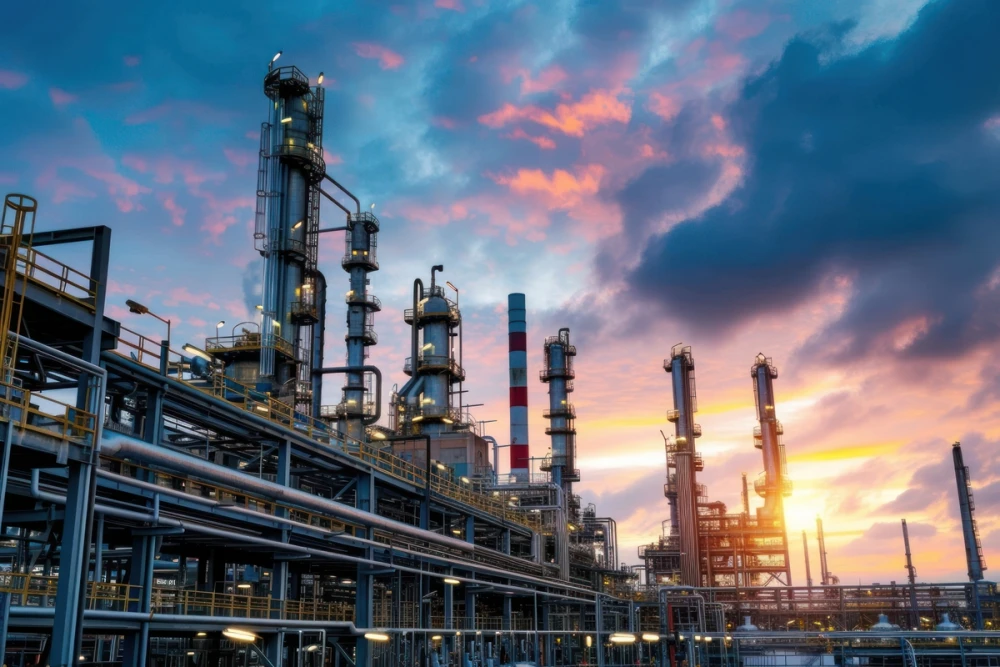
Iraq ranks among the world's leading oil-producing countries and holds one of the strongest resource bases in the Middle East. The bulk of production is concentrated in the south of the country, where the giant fields of Rumaila, West Qurna, Zubair, and Majnoon are located. It is precisely these southern assets that shape Iraq's export stream, budget revenues, and role within OPEC.
For the topic of "oil production in Iraq," two characteristics are important. The first is a very high concentration of production at a handful of giant fields in Basra and the south of the country. The second is a strong dependence on export and field infrastructure: reservoir water injection, associated-gas gathering, the operation of southern terminals, and the throughput capacity of routes through Basra. The Iraqi oil industry, therefore, is not only about large reserves but about constant work with infrastructure bottlenecks.
Historical overview of the oil industry
Iraq's oil industry is one of the oldest in the Middle East. The Kirkuk district became an early symbol, where large-scale production and export infrastructure was established in the first half of the 20th century. The northern fields long determined the external perception of Iraqi oil, but the centre of gravity subsequently shifted increasingly to the south.
In the second half of the 20th century, and especially after the 2000s, the giant fields in the Basra area became the main source of growth. This changed both the geography of the industry and its logic: exports came to rely primarily on southern terminals in the Persian Gulf, and production stability on enormous but mature fields that require ever-greater volumes of water injection, well workovers, and gas infrastructure development.
Modern Iraq is instructive as an example of a country where vast conventional resources are combined with a strong dependence on field infrastructure. Unlike the US shale model or Canada's heavy-oil model, Iraqi oil production is built on super-large conventional reservoirs with relatively low lifting costs, but with very high requirements for water, gas gathering, pipelines, and export terminals.
Geography of oil and gas basins and major fields
Iraq's main oil district is the south of the country, above all Basra Province and adjacent territories. World-class fields are concentrated here, accounting for the bulk of production and exports. The north of Iraq is historically important thanks to Kirkuk, but in terms of current significance it is the southern group of assets that forms the industry's core.
Rumaila is Iraq's largest producing field and one of the largest in the world. Located approximately 50 km west of Basra, it covers around 1,600 sq km and produces about one-third of all Iraqi crude. It is the key asset for the entire Iraqi upstream sector: any changes at Rumaila are quickly reflected in national statistics, exports, and the budget.
West Qurna-1 and West Qurna-2 are two super-large fields in southern Iraq. According to EIA, West Qurna-1 had a current capacity of around 550 thousand bbl/day with a target of approximately 800 thousand bbl/day, while West Qurna-2 was at approximately 480 thousand bbl/day at end-2023 with a project target of around 800 thousand bbl/day. These assets are especially important for future production growth.
Majnoon is another strategic southern project. EIA indicated plans to add approximately 200 thousand bbl/day of capacity. For Iraq, Majnoon is important not only as a source of crude but also as part of a broader scheme to develop gas gathering and associated-gas processing in the southern oil districts.
Zubair, Ratawi, Halfaya, Nasiriya, and the group of Kirkuk fields also remain key nodes. For Kirkuk, a new contract was signed with BP in 2025 for the rehabilitation of four fields in the region, with their combined capacity planned to be raised from approximately 300 thousand bbl/day to 420–450 thousand bbl/day. This is one of the most significant projects in northern Iraq in recent years.
Current production status in 2024–2025
In 2024, Iraq produced an average of approximately 4.4 million bbl/day of crude oil and approximately 4.5 million bbl/day of total petroleum liquids. This is one of the highest levels in the world and second place within OPEC after Saudi Arabia. The production structure remained uneven: approximately 4.1 million bbl/day came from federal Iraq, with an additional approximately 300 thousand bbl/day from northern assets under Kurdistan Regional Government management.
Understanding Iraqi production statistics requires not conflating actual output with project plans. The Ministry of Oil traditionally sets very high capacity targets and has announced intentions to raise capacity above 6 million bbl/day by 2029 and, in some documents, to 7 million bbl/day of production potential. In practice, however, the pace of growth depends on far more prosaic factors: water availability for injection, expansion timelines at West Qurna and Majnoon, readiness of the export system at Basra, and compliance with OPEC+ quotas.
In 2025, Iraq's baseline production profile remained strong, but the market increasingly looked not only at output volumes but also at the country's ability to consistently export additional barrels. This is why it is insufficient for Iraq simply to open or expand a field — it must also ensure terminals, subsea export lines, pumping stations, and reserve capacity for further growth of seaborne shipments.
Production technologies and operational characteristics
Technologically, Iraqi oil production relies on large conventional reservoirs, but this does not mean straightforward operations. Many southern fields are mature giants that require large volumes of water to maintain reservoir pressure. Water injection is therefore one of the key engineering topics in Iraq. EIA separately notes TotalEnergies' seawater conversion project with a capacity of approximately 7.5 million bbl/day, which is intended to sustain production at mature southern fields.
The second important topic is associated gas. Iraq is characterised by a combination of high oil production and a chronic shortage of gas gathering, processing, and utilisation capacity. This explains the recent strong focus on Basra Gas Company projects, Halfaya gas processing, and the gas component of the TotalEnergies deal. For the industry, this is a practical issue: less flaring and greater gas utilisation directly improve the overall sustainability of production.
The third characteristic is the scale of rehabilitation of the existing well stock. At Kirkuk, BP is returning not simply to drill new wells but to restore and expand existing infrastructure: pipelines, treatment facilities, gas facilities, and the legacy well stock. For Iraq, this is typical: production growth often depends not so much on opening new fields as on modernising already well-known giants.
Export strategy and role in the global market
Iraq is a pronounced export-oriented producer. In 2024, seaborne crude exports exceeded 3.2 million bbl/day. This entire seaborne flow passed through the southern Persian Gulf terminals throughout the year, exporting primarily the Basra Medium and Basra Heavy grades. For global trade, this makes Basra a key node not only for Iraq but for a substantial share of Middle Eastern oil supply.
Asia remains the primary sales market. In 2024, it accounted for approximately 72% of Iraqi exports, with China and India being the largest buyers. Europe also remains an important destination, but its share is noticeably lower than that of the Asian markets. For educational text authors, there is a useful fact here: China and India together took approximately 62% of Iraqi exports, meaning it is Asian demand that determines the commercial logic of Iraqi crude.
The northern route via the Iraq–Türkiye Pipeline was for a long time an important export channel, but following the line's shutdown in 2023 the role of southern terminals has grown even further. This has increased the vulnerability of the export system: when almost all oil departs through one primary region, any delays with terminals, subsea lines, or capacity congestion begin to constrain production as well.
Challenges facing the industry
The primary challenge for Iraq's oil industry is not a shortage of resources but an infrastructure gap relative to the scale of reserves. The country possesses a vast base of conventional oil, but monetising it sustainably requires new export lines, sea terminals, water injection systems, gas capacity, and pipeline modernisation.
The second cluster of problems involves bottlenecks in the south. The operational export capacity in the Basra region was estimated at approximately 3.4 million bbl/day in mid-2024. That is substantial, but for a country that wants to grow noticeably it is already insufficient. This is precisely why projects such as Sealine 3, Sealines 4 and 5, the development of new single-point mooring buoys, and the renovation of ageing subsea lines are so important.
The third challenge is water and gas. The southern fields cannot long sustain production growth without large-scale reservoir pressure maintenance projects. At the same time, Iraq needs to improve the capture and processing of associated gas; otherwise part of the oil potential will continue to run up against energy and technology constraints.
Development outlook
Iraq's medium-term prospects remain strong precisely because the country is working with very large and comparatively low-cost conventional resources. If expansions are realised at West Qurna-1, West Qurna-2, Majnoon, Ratawi, and in Kirkuk, Iraq will be able to materially increase its production potential. The advantage is that the resource base for such growth already exists; the disadvantage is that it requires very substantial infrastructure support.
The southern cluster is of particular importance for the future. The TotalEnergies seawater project, associated-gas gathering expansion, an increase in Basra throughput capacity, and rehabilitation of northern assets are not separate news items but elements of the same scenario: transitioning Iraq from merely large-scale production to a more sustainable and scalable system.
For students and report authors, Iraq is useful as an example of a classic oil power with enormous conventional reserves. Here it is clear that even with a strong geological base, the actual level of production is determined not only by subsurface conditions but also by thoroughly practical engineering parameters: water, pipelines, terminals, gas gathering, and the export regime.
Conclusion
Iraq remains one of the world's central oil nations. Its strength lies in vast reserves, giant southern fields, and high export significance for Asian markets. Rumaila, West Qurna, Majnoon, Zubair, and Kirkuk form the backbone of the industry, while Basra remains the country's principal export gateway.
The key takeaway on the topic of "oil production in Iraq" is simple: this is not a country short of resources — it is a country of infrastructural scale. Iraq can produce more, but to do so it needs to synchronously expand output, water injection, gas processing, and maritime exports. It is precisely within this interdependence that the future of the Iraqi oil industry resides.
For drilling, field development, and oilfield operations projects, Burmetsnab supplies drill pipe, casing pipe, and tubing (NKT). Such tubular products are in demand at production sites where reliability, service life, and resistance to real-world stresses in oil production and transport are essential.
Need pipe for your project?
We will select pipe to match your specification and schedule. Price on request.