

Oil production in Nigeria
Oil production in Nigeria: Niger Delta, Bonny Light, Bonga, Egina, Agbami, FPSO, production volumes, export and development outlook.
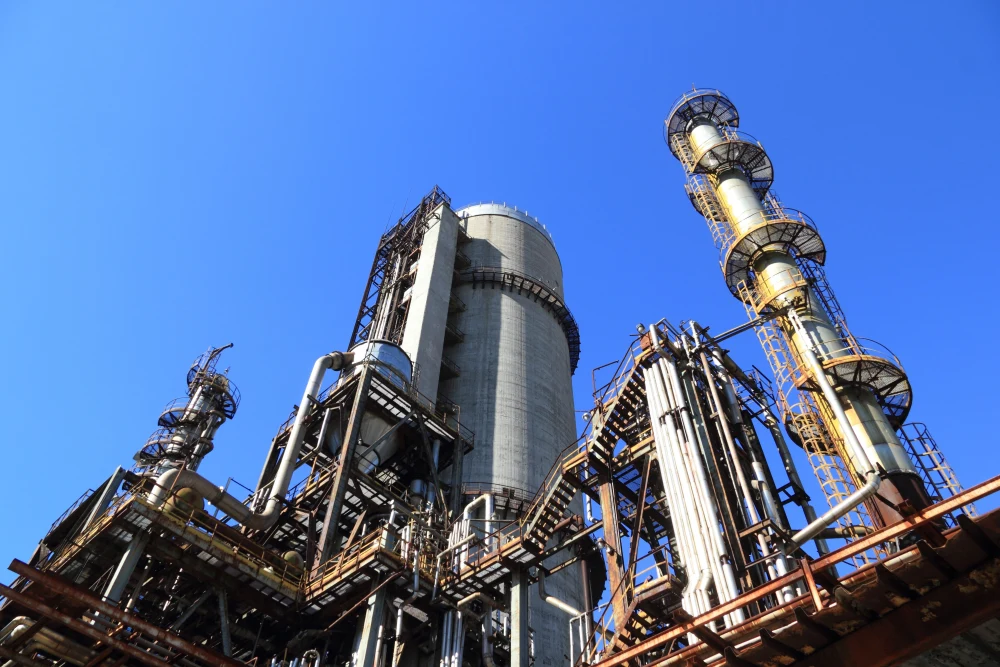
Nigeria is Africa's largest oil-producing country and one of the best-known suppliers of light, low-sulphur crude on the global market. The industry's foundation is concentrated in the Niger Delta Basin, where production is conducted onshore, in swamp zones, on the shallow shelf, and in deepwater areas of the Gulf of Guinea. This is precisely what makes Nigeria's oil industry particularly interesting: within one country, mature onshore assets, export terminals with well-known grades such as Bonny Light, Forcados, and Qua Iboe, and large deepwater projects — Bonga, Egina, Agbami, and Akpo — all coexist.
For a practical understanding of the topic of "oil production in Nigeria," it is important to remember that the country's problem has long ceased to be a lack of resources. Nigeria holds very large reserves and high-quality export crude, yet actual production frequently remains below technical capacity due to infrastructure losses, field ageing, pipeline system constraints, and chronic problems in onshore logistics. Nigerian oil production is therefore a good example of how the gap between reserves and actual output is formed not by geology but by operations and transport.
Historical overview of the oil industry
The history of oil production in Nigeria is associated above all with the Niger Delta. It was here that the largest onshore and swamp fields were discovered and brought into production, and Nigerian crude export grades came over time to be well known in the global market. For decades, the industry was built around a system of delta production, trunk pipelines, export terminals, and deliveries of light sweet crude to Europe and the USA.
Subsequently, a significant share of strategic interest shifted toward offshore and especially deep offshore. This part of the oil system gave Nigeria next-generation projects — Bonga, Agbami, Akpo, Egina, and Usan. Against the background of chronic onshore problems, deepwater assets came to be seen as a more stable and manageable segment of the industry. This is one of the most important turning points in Nigerian oil history: the move from traditional delta production to the growing role of FPSOs and deepwater clusters.
As a result, Nigeria today combines several oil models. On one side, it is a classic onshore country with export terminals at Bonny, Forcados, Brass River, Escravos, and Qua Iboe. On the other, it is a major deepwater producer, with offshore assets of global scale. For educational materials, this is a very convenient case: one country allows comparison of onshore, swamp, shallow-water, and deepwater production within a single oil system.
Geography of oil and gas basins and major fields
Nigeria's principal oil province is the Niger Delta Basin. In practice, the country's oil geography divides into four zones: land, swamp, offshore, and deep offshore. According to NUPRC, in 2024 the contribution of these zones was distributed as follows: approximately 31% came from onshore production, 15% from swamps, 26% from conventional offshore, and 29% from deep offshore. These figures alone show that Nigeria has long ceased to be only an onshore country: the deepwater sector has become almost equal in importance to the onshore.
Onshore and in the coastal zone, the key assets remain those linked to the export streams of Bonny Light, Forcados, Qua Iboe, Brass River, and Escravos. These names are known not merely as export grades but as elements of an entire infrastructure system: fields, pipelines, gathering stations, and terminals. Crude quality here is high: according to EIA data, Bonny Light has approximately 35° API and 0.15% sulphur; Forcados approximately 32° API and 0.20% sulphur; Qua Iboe approximately 38° API and 0.12% sulphur. It is precisely the low sulphur content and relatively light gravity that make Nigerian crude competitive in the global market.
In deep offshore, the primary projects remain Bonga, Egina, Agbami, Akpo, and Usan. Bonga is Nigeria's first major deepwater oil project and one of the symbols of its offshore production. Shell indicates Bonga's capacity at 225 thousand bbl/day, and the project extracted its billionth barrel as far back as 2023. For the Nigerian industry, this is not merely a large field but an anchor deepwater node around which further expansion projects are also structured.
Egina is another flagship offshore project. TotalEnergies directly states its design capacity at 200 thousand bbl/day. The field is located at water depths of approximately 1,400–1,700 metres and operates through one of the largest FPSOs in Nigerian history. For the country, Egina is important because it demonstrates the transition of the Nigerian industry to a higher-technology offshore production model.
Agbami is one of Nigeria's largest deepwater discoveries. Chevron describes it as one of the country's largest deepwater production fields, and the Agbami FPSO was designed for approximately 250 thousand bbl/day. Together with Bonga and Egina, this asset forms the segment of the Nigerian oil system that is generally considered more stable than onshore delta production.
Among the more recent growth sources, Akpo West, Ikike, and Utapate deserve attention. EIA directly indicates that it was these projects that delivered part of the 2024 increment and helped offset declines at legacy fields. An interesting fact: in 2024 and 2025, two new grades entered the market — Utapate and Obodo — underscoring the continued renewal of the production portfolio even amid general infrastructure challenges.
Current production status in 2024–2025
According to official NUPRC data, in 2024 Nigeria averaged approximately 1,580 thousand bbl/day of oil plus condensate, of which approximately 1,319 thousand bbl/day was crude and 261 thousand bbl/day was condensate. EIA also estimated combined crude and lease condensate production at approximately 1.5 million bbl/day. For a country with reserves of approximately 37.5 billion barrels, this is a comparatively moderate level, especially considering that the technically permitted potential was noticeably higher.
This is also evident from Technical Allowable Rate data. NUPRC indicated that in the first half of 2024 the approved TAR for oil plus condensate was approximately 2,335 thousand bbl/day and in the second half approximately 2,230 thousand bbl/day. Actual production was approximately one-third lower. This gap is especially important for understanding Nigeria's oil industry: the country is not running up against a shortage of reserves — it is running up against the inability to reliably extract and deliver the full available volume to market.
In 2025, the situation began to improve. According to NUPRC, in July 2025 production was approximately 1,710 thousand bbl/day of oil plus condensate, of which approximately 1,507 thousand bbl/day was crude. This was a notable year-on-year increase. Even such a result, however, still fell below the target levels that the regulator and government had discussed as desirable for the budget and the industry.
The practical conclusion here is straightforward: modern Nigerian oil production is an industry with strong resource and export potential that is gradually recovering from weak years but has not yet reached the level corresponding to its geological capabilities. For an SEO text, academic report, or essay, this is one of the most important facts about the country.
Production technologies and operational characteristics
Technologically, the Nigerian industry is very heterogeneous. Onshore and in swamp areas, more traditional development schemes are applied, but these segments more often suffer from pipeline constraints, production gathering limitations, and logistics issues. In contrast, deep offshore relies on modern marine infrastructure, subsea production systems, and FPSOs. This is precisely why projects such as Bonga, Egina, and Agbami frequently appear more robust from a production standpoint.
FPSOs are especially important for the deepwater segment. At Egina, it is Nigeria's largest floating production, storage, and offloading system, rated at 200 thousand bbl/day. At Bonga, capacity is 225 thousand bbl/day. The Agbami FPSO was designed for approximately 250 thousand bbl/day. For the country, this is the key technology: it allows oil to be produced at great depths and offloaded without full dependence on onshore pipeline systems, which frequently prove to be the weak link onshore.
Onshore and in shallow-water segments, the characteristics differ. Here, pipeline protection, export terminal operations, timely oil offtake and gathering, well-stock workovers, and loss prevention are especially important. This makes the Nigerian model very instructive for engineering and academic work: production may be geologically relatively "straightforward," but the actual result is determined by the state of midstream infrastructure and transport security.
Crude quality deserves separate attention. Nigerian crude is predominantly sweet and comparatively light or medium-light. EIA notes directly that such grades typically trade at a premium to certain other benchmarks because of low sulphur content and favourable refining characteristics. This is an important technological and commercial advantage for the country: Nigerian barrels are valued not only by volume but also by quality.
Export strategy and role in the global market
Nigeria is primarily an export-oriented producer. The bulk of produced crude and condensate goes to external markets. In 2024, according to EIA, the country exported approximately 1.3 million bbl/day of crude and condensate. This is not a record by historical standards, but it confirms that the external market remains the main channel for monetising Nigerian oil production.
The distribution across markets is noteworthy. In 2024, the largest export destination was Europe, which received approximately 622 thousand bbl/day. The Asia-Pacific region imported approximately 276 thousand bbl/day, with India and Indonesia being the largest buyers. This is an important fact for educational materials: while Nigeria is traditionally associated with deliveries to the USA and Europe, the actual geography of its sales has long become more diversified.
Nigeria's export strategy is anchored on a system of terminals and grades. Bonny Light, Forcados, Qua Iboe, Escravos, Brass River, Bonga, Agbami, Akpo, Egina — these are not simply crude names but elements of a specific export infrastructure. It is through the combination of fields, pipelines, and terminals that Nigeria converts production into a marketable export barrel.
A separate factor of recent years is the commissioning of the Dangote refinery. According to EIA, this refinery with a capacity of 650 thousand bbl/day began commercial operations in 2024 and has already materially changed the petroleum products balance. In 2024, petroleum products exports grew to 146 thousand bbl/day from 46 thousand bbl/day the previous year. For the country's oil system, this is an important shift: Nigeria is gradually ceasing to be only an exporter of crude and is beginning to strengthen domestic refining.
Challenges facing the industry
Nigeria's primary challenge is the gap between reserves, technical potential, and actual production. On paper, the country has a very large resource base and production capacity exceeding 2 million bbl/day. In practice, in 2024 it produced approximately 1.58 million bbl/day of oil plus condensate. It is precisely this gap that explains most of the discussion about the industry's future.
The second cluster of problems relates to the state of infrastructure. EIA directly references ageing and poorly maintained crude oil infrastructure as well as frequent supply disruptions. For Nigeria, this means that pipelines, terminals, gathering systems, and onshore facilities remain critical production constraints. Even if the reservoir and wells permit higher output, the oil must still be evacuated to the terminal safely and without losses.
The third challenge is the maturity of some fields. Many of the older onshore fields have been in operation for a long time, and without large investments their productivity naturally declines. This is precisely why new deepwater projects and projects such as Akpo West, Ikike, and Utapate are so important: they deliver not only new barrels but also a partial offset to the decline in the legacy well stock.
Finally, the challenge of balancing upstream and refining is also relevant for Nigeria. The Dangote refinery start-up is a plus for the country, but it requires a reliable crude feedstock supply, dependable logistics, and correct integration of oil production with refining. This system is still in a calibration phase.
Development outlook
Nigeria's medium-term prospects look moderately positive. The country's strengths are high-quality crude, a large resource base, and deepwater projects that can remain the anchor for growth. In 2024–2025, production has already been gradually recovering thanks to fewer disruptions and the launch of new projects. If this trend continues, the country will be able to return to higher output levels.
The offshore segment is especially promising. Bonga, Egina, Agbami, Akpo, and the new deepwater expansions look like the most technologically robust direction of Nigerian oil production. Shell and other major operators continue to view offshore as the primary long-term priority, especially as some international companies exit onshore assets.
At the same time, onshore and swamp segments remain extremely important. They provide a significant share of national production and retain an enormous resource base. Nigeria's further growth will therefore depend on whether the country can simultaneously sustain deepwater as a stable source of barrels and improve the efficiency of onshore infrastructure operations in the Niger Delta.
For students, analysts, and presentation authors, Nigeria is particularly interesting as an example of a country where very high-quality crude and large reserves do not guarantee proportionally high production. This is one of the best global case studies for explaining how midstream, export terminals, FPSOs, field maturity, and asset structure determine actual production volumes.
Conclusion
Nigeria occupies a unique place on the world oil map. It is Africa's largest oil producer, a supplier of quality sweet grades, and simultaneously a country with a large gap between its resource base and actual production. The country's principal oil geography is the Niger Delta and adjacent offshore, where onshore clusters — Bonny, Forcados, Qua Iboe — and large deepwater projects — Bonga, Egina, Agbami, and Akpo — coexist.
The key takeaway on the topic of "oil production in Nigeria" is that reserves alone do not determine outcomes. For real growth the country needs stable pipelines, efficient exports, infrastructure modernisation, and continued development of offshore projects. This is precisely why Nigeria is so interesting for search queries, academic materials, and applied analysis of the global oil industry.
For drilling, well development, and operations projects, Burmetsnab supplies drill pipe, casing pipe, and tubing (NKT). Such tubular products are in demand wherever reliability, service life, and resistance to demanding production, workover, and crude-transport conditions are essential.
Need pipe for your project?
We will select pipe to match your specification and schedule. Price on request.